
Angelina County Sex Offender Checks
The official starting point is the Texas Public Sex Offender Registry. Texas DPS compiles registration data sent by local law-enforcement authorities. Select Angelina County for a countywide list, use a name when the person is known, or begin with an address and map when the question concerns a nearby place. These routes query the same state system but answer different questions. A name search is best for confirming a person. A map search is better for reviewing a defined area.
Results can change as an address, status, or verification entry is updated. Match more than a name. Compare the photograph, age, physical description, aliases, registering agency, and offense details before drawing a conclusion. The registry is a public-notification tool, not a live finding that someone committed new misconduct. For an Angelina County entry that appears unclear, call the sheriff's registration line and ask about current public information.
Angelina County Offender Registration
The Angelina County Sheriff's Office handles local registrations within its jurisdiction and reports the data to DPS. Its sex-offender registration line is 936-639-8734, and the sheriff and jail complex is at 2311 East Lufkin Avenue, Lufkin, Texas 75901. Call before visiting for current appointment and reporting instructions. The direct line matters because the public profile cannot answer every administrative question about a recent update or local verification.
Angelina County Sheriff
Sex Offender Registration
2311 E. Lufkin Ave.
Lufkin, TX 75901
936-639-8734
The official sheriff division contacts page shows the county's specialized line. Use it for nonemergency registration questions. Call 911 for an immediate threat.
Texas Public Sex Offender Registry Searches
Texas DPS offers name, address and map, and higher-education search tabs. Angelina County searchers should accept the conditions shown by the live portal, choose the mode that fits the question, and narrow cautiously. Common names and partial entries can return several people. Geographic searches depend on a sound starting address and the current registered location.
- Open the DPS registry and review its conditions of use.
- Choose name search or address and map search, then enter the known fields.
- Select Angelina County or refine with city, ZIP code, and radius controls.
- Open a possible match and compare the full profile before relying on it.
| Field Label | Type | Required | Notes |
|---|---|---|---|
| Last Name | Text | Conditional | Used for a name search; partial or common names may create several results. |
| First / Middle Name | Text | No | Narrows a name search. |
| Address / City / ZIP | Text or selector | Conditional | Provides the center point for a geographic search. |
| County | Selector | No | Select Angelina for countywide results. |
| Radius and Map/List | Selector and view | Conditional | Sets the area and switches between geographic and tabular views. |
Angelina County Registry Map Searches
Name and map searches are complementary. Use the name fields when confirming a known person, adding first and middle names to reduce false matches. Use an Angelina County address search for community awareness around a home, school route, or other place. A radius result is only as reliable as the address data and boundary selected. It should not be read as a claim that no registrant is present beyond the displayed area.
The registry image captured from the official Texas DPS search shows the statewide entry point used for both approaches.
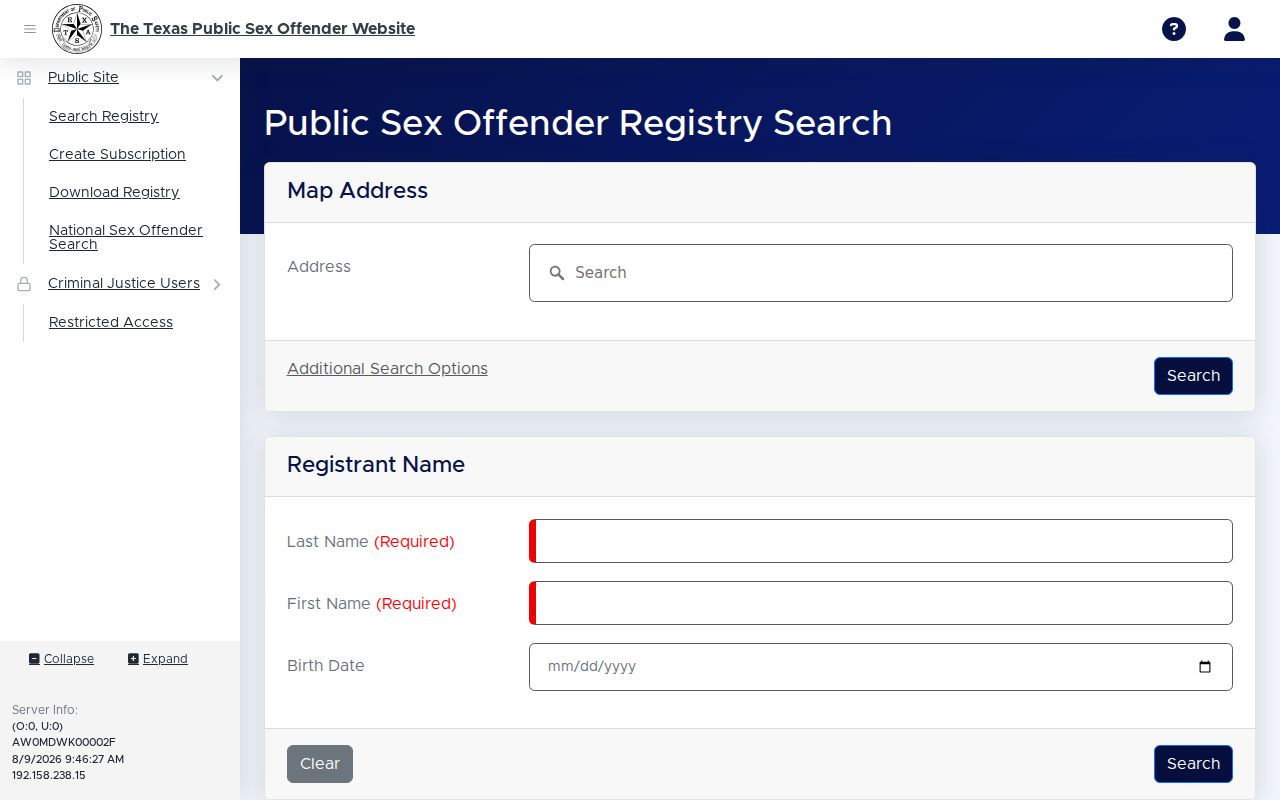
Starting with the right tab reduces noise, but each possible match still needs a full-profile review.
Registry Profiles: What They Show
A public profile joins identity, location, reporting, and offense fields so the reader can distinguish people with similar names. It may show a recent photograph, aliases, date of birth or age, sex, race, physical traits, scars or marks, registered address or location, status, risk level when assigned, registering agency, and verification information. Offense details can include the reportable offense, statute, conviction date, jurisdiction, victim age category, and sentence or release data.
| Name & Aliases | Registered name and alternate names used to separate similar identities. |
|---|---|
| Photo & Physical Description | Recent image plus entered age, sex, race, height, weight, hair, eyes, scars, marks, or tattoos. |
| Registered Address | Public address or location information reported under the registration rules. |
| Offense & Statute | Reportable offense, legal citation, conviction date, jurisdiction, and related public case facts. |
| Risk Information | Low, moderate, or high risk when an assessment has been assigned. |
| Registration Status | Registering agency and public verification or reporting information. |
Angelina County Registry Privacy
A public listing is not the complete government registration file. DPS excludes Social Security and driver's-license numbers, phone numbers, online identifiers, employer details, victim identity, and other information designated as nonpublic. A juvenile court can also order juvenile registration kept from public display. Absence from the public view therefore does not mean a field was never collected.
Vehicle information may appear for categories specified by law. The line between displayed and withheld data protects personal and victim information while preserving the notification facts authorized for release. Angelina County residents should use only what DPS displays and should not try to obtain excluded details through harassment or pretext.
Registration Levels and Duties in Texas
Texas does not publish a simple consumer-facing Tier I, II, and III duration chart. Chapter 62 generally ties the duty to the reportable offense and related statutory categories. Adult registration may last ten years after discharge from incarceration, parole, or community supervision, or it may last for life. Risk level is separate. A low, moderate, or high assessment affects notification, but it does not by itself set the registration term.
| Texas Category | General Duration | Public Effect |
|---|---|---|
| Reportable offense not assigned lifetime registration | Generally ten years after discharge from custody or supervision | Public listing when Chapter 62 authorizes it |
| Sexually violent and other enumerated lifetime categories | Lifetime | Public registration and applicable notification |
| High-risk or civilly committed category moving into a community | Underlying offense-based term | DPS describes postcard community notification |
| Court-ordered nonpublic juvenile registration | As ordered under the juvenile provisions | Not displayed publicly |
Angelina County Registry Risk Labels
Two labels answer two different questions. Duration asks how long Chapter 62 requires a person to register. Risk describes an assessed likelihood used in community-notification decisions. A moderate or high label is not a shortcut for calculating the end date, and a ten-year category is not automatically a statement about risk.
The Texas DPS registration program page explains the state framework and public-notification role.
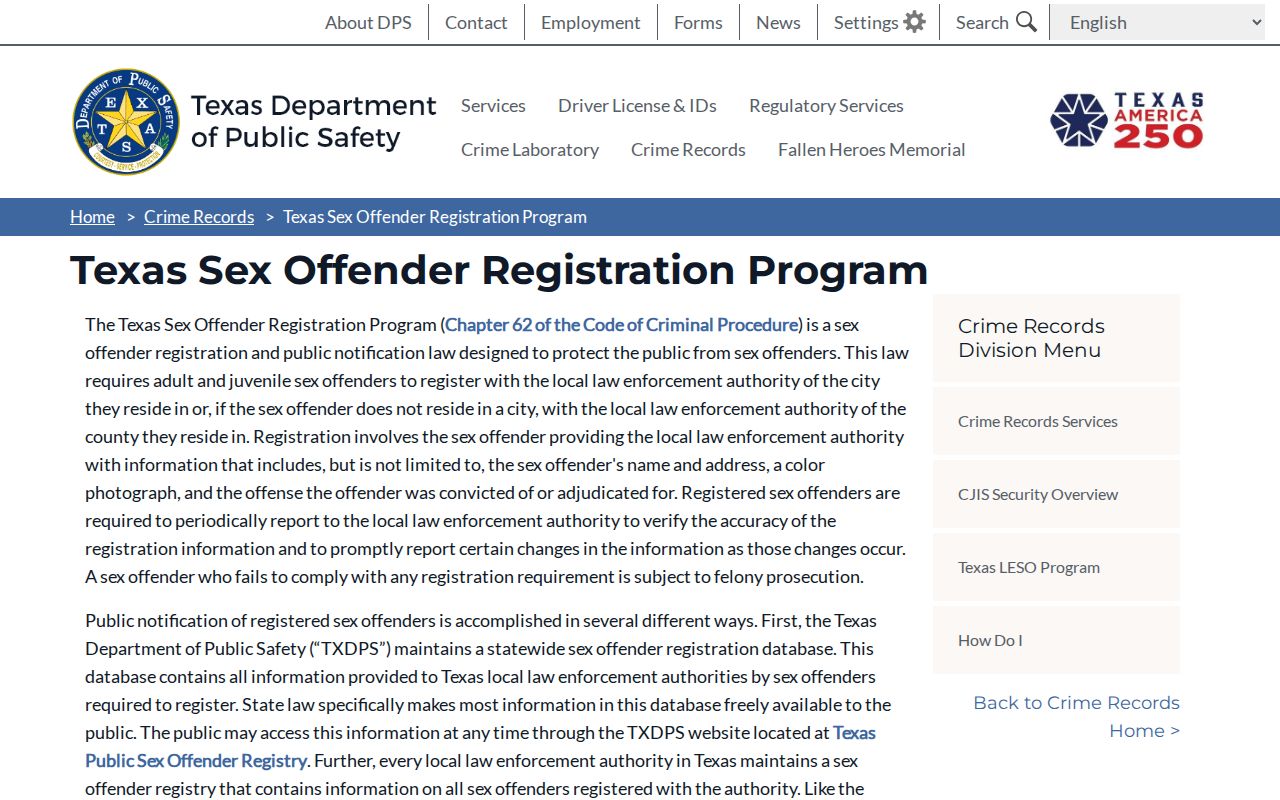
For a particular Angelina County profile, read the displayed offense and status fields, then direct administrative questions to the registering agency.
Angelina County National Registry Searches
The DPS registry is the strongest first source for Angelina County because Texas agencies maintain and submit the underlying state records. The National Sex Offender Public Website, or NSOPW, is useful when a search crosses state lines or the location history is uncertain.
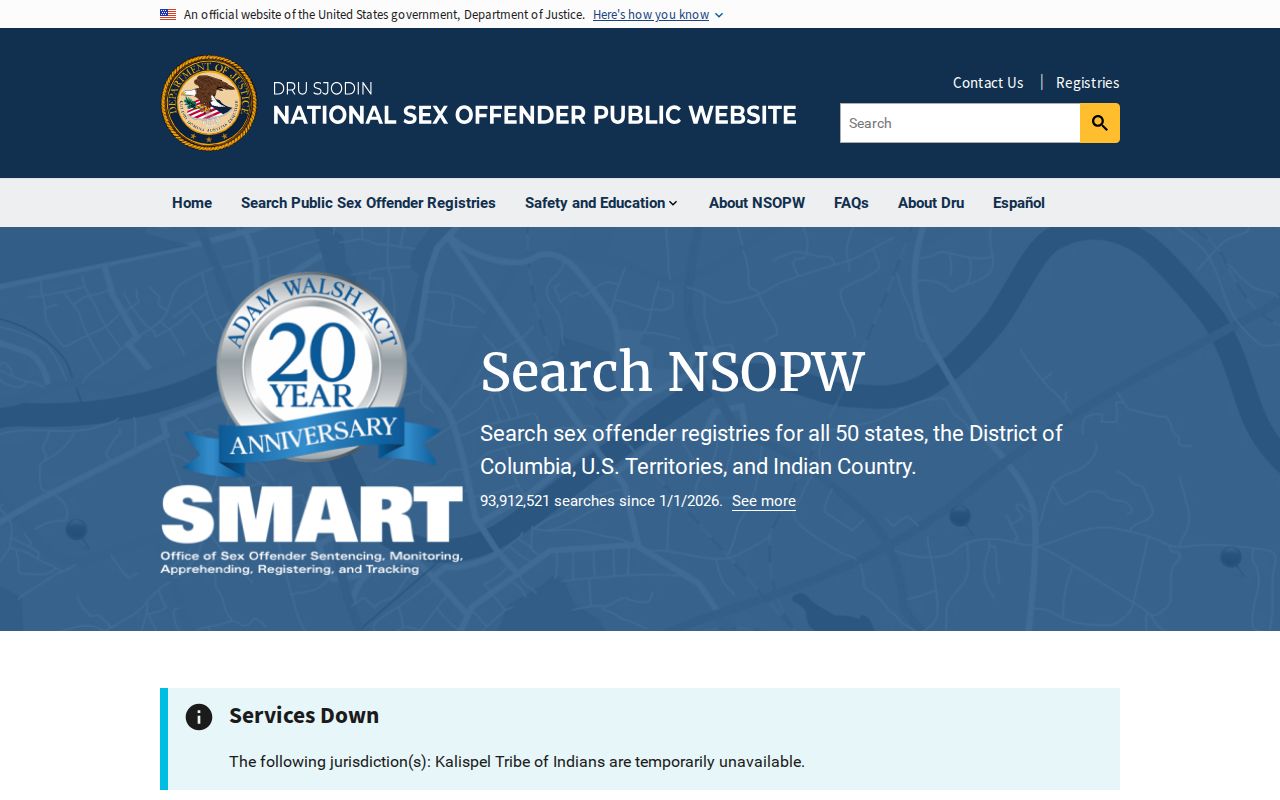
NSOPW connects participating jurisdictions, while DPS remains the direct source for a Texas listing. Compare identifiers across results instead of assuming the same name means the same person.
Using Angelina Registry Information Lawfully
Registry information supports personal, family, and community safety planning. Texas may provide statutory notice to schools in qualifying circumstances, and DPS describes postcard notification for certain high-risk or civilly committed people moving into a community. Local authorities may publish other notices allowed by law. None of those steps converts the registry into proof of present misconduct.
Report suspected noncompliance to the registering law-enforcement agency or local police. Do not confront a person or household. Texas also has no single distance rule that applies identically to every registrant statewide. Parole or probation conditions and municipal rules can differ, so verify any local restriction through the responsible authority.
The controlling Texas Code of Criminal Procedure Chapter 62 sets the registration framework.
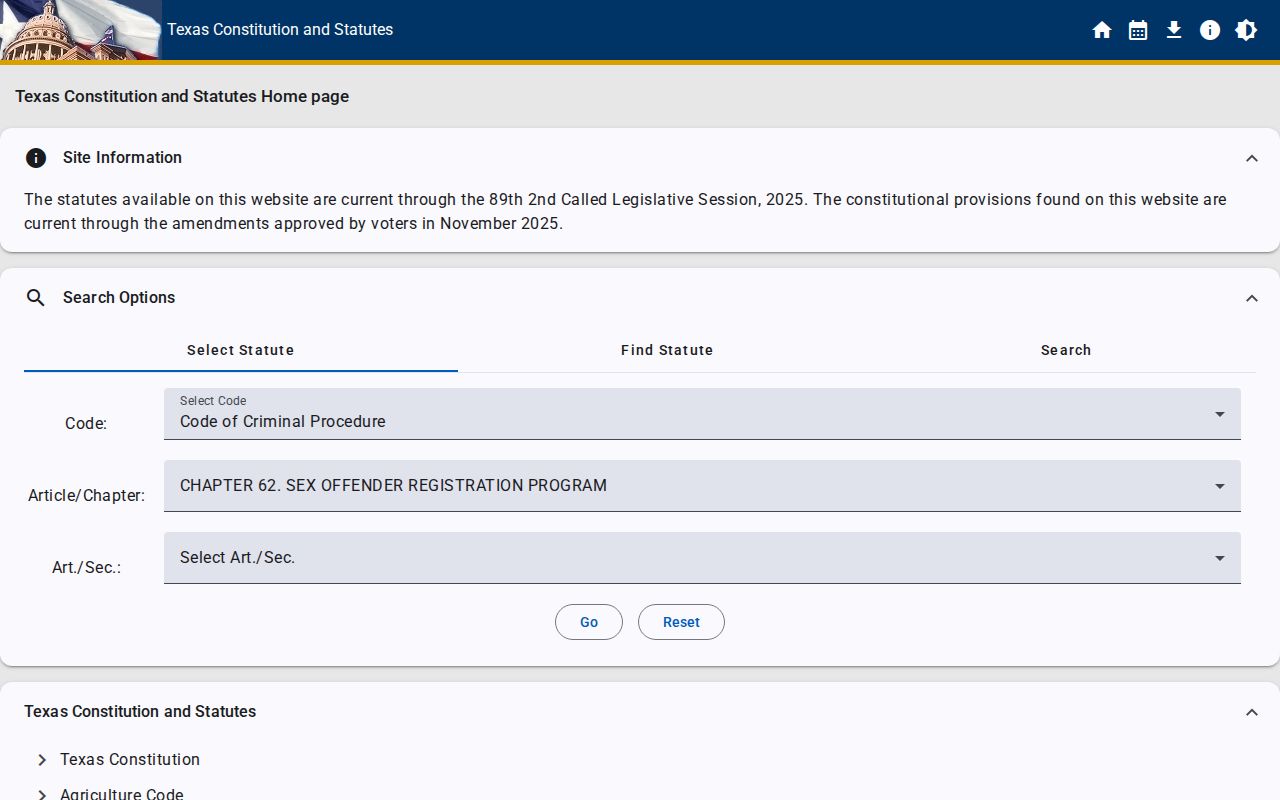
The statute supplies the legal rules behind the public profile, duration categories, and notification system.
Use the registry lawfully: Misusing Chapter 62 information to harass, threaten, or intimidate a registrant or household is a crime. Use it for safety awareness, not vigilantism.